What Cortisol Is Costing You in Trading
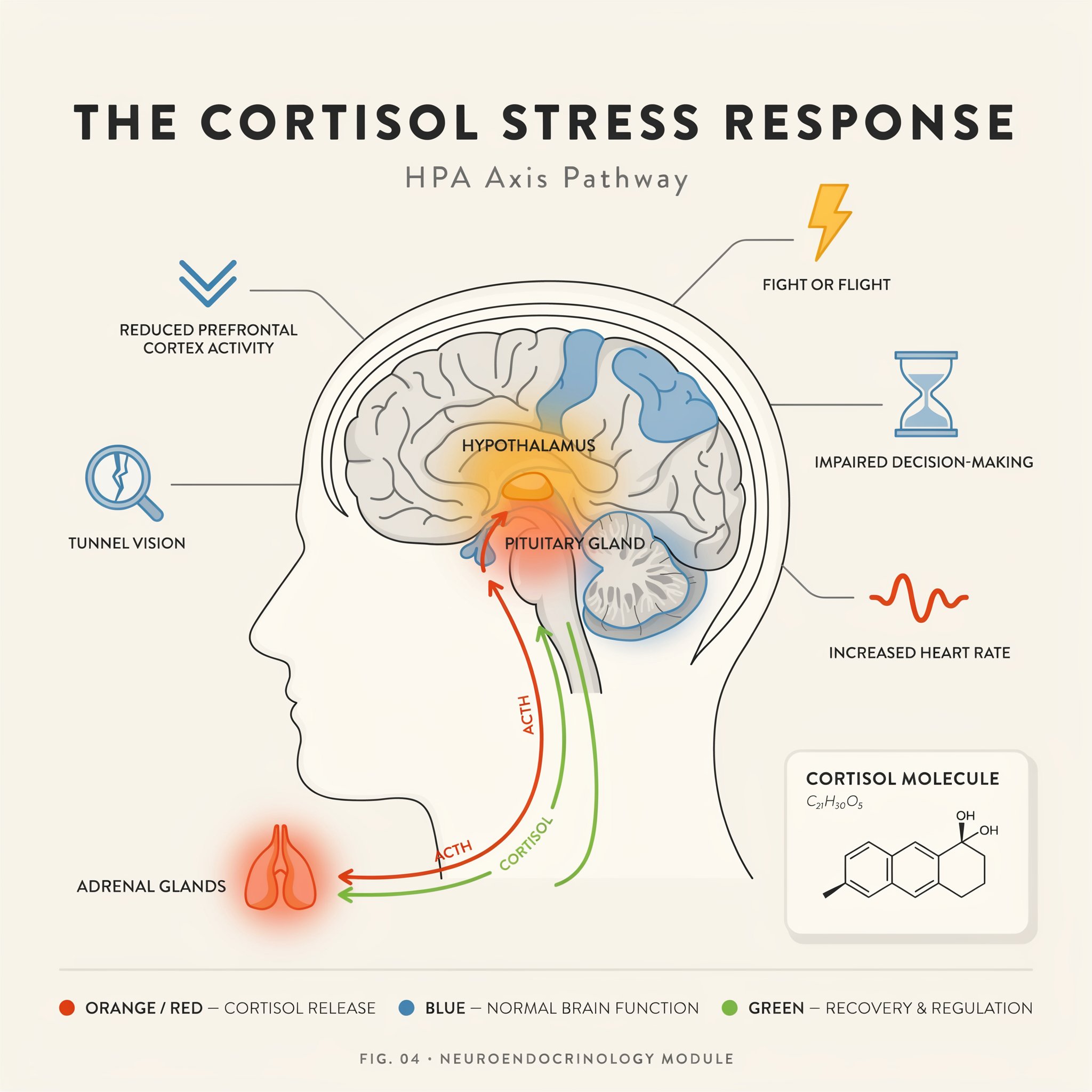
Trading psychology is often discussed as an abstract topic: fear, greed, discipline. What usually goes unmentioned is that these states have a measurable physiological basis, one that's been studied directly on trading floors.
An experiment run on real traders
John Coates, a neuroscientist at Cambridge and former derivatives trader at Wall Street, led a study measuring salivary cortisol in traders over two weeks of market volatility. Cortisol levels tracked volatility with a very strong correlation. In a follow-up lab experiment, the team administered hydrocortisone to volunteers and found that chronically elevated cortisol caused risk appetite to drop by 44%.
The implication is counterintuitive: traders don't become bolder when the market crashes. Often the opposite happens. Under chronic stress, the body pushes toward excessive caution, sometimes at odds with the trader's own plan.
Cortisol and testosterone don't play the same role
A study published in Scientific Reports showed that both cortisol and testosterone increase financial risk-taking, but through different mechanisms. Coates' work suggests cortisol codes more for risk perception, while testosterone is more associated with reward-seeking. A trader with high testosterone and low cortisol doesn't have the same decision profile as one under chronically elevated cortisol, even though both might simply look "stressed" from the outside.
Why loss aversion makes it worse
The foundational work of Kahneman and Tversky on prospect theory shows that losses are felt roughly twice as intensely as equivalent gains. Combined with already elevated cortisol after a string of losses, this bias can turn a rational decision to cut a losing position into a pure emotional freeze. The body and the cognitive bias work in the same direction, against the trader.
What the trading literature says about it
Mark Douglas develops the idea that the market cannot hurt a trader emotionally if they have already accepted the risk of each trade in advance. This advance acceptance of risk, which he sometimes calls thinking in probabilities, can be read as a strategy that directly limits cortisol spikes tied to perceived uncertainty: less felt surprise, a weaker acute stress response.
Practical levers
You can't measure your cortisol before every session, but you can act on its behavioural correlates: sleep, position sizing matched to your stress level for the day, taking a break after a losing streak instead of immediately doubling down. Logging your physical and emotional state before each session, as trading psychology tracking tools allow, builds a history that helps you spot your own warning signs before they cost you money.
In summary
Trading psychology isn't a metaphor. Hormones measurable in a lab directly influence risk appetite, and this influence has been documented on real traders under real conditions. Understanding the mechanism doesn't remove the stress, but it stops you from being blindsided by it.
EloTrades is trading journal, analytics and simulation software. It provides no investment advice, signals or recommendations, and executes no orders. Trading involves a risk of capital loss, which may be total.